Excerpt From "The Plow That Broke The Plains"
Tuesday, February 23, 2010
Axis Mundi
The cry of the Kwakiutl neophyte, "I am at the Center of the World!" at once reveals one of the deepest meanings of sacred space. Where the break-through from plane to plane has been effected by a hierophany, there too an opening has been made, either upward (the divine world) or downward (the underworld, the world of the dead). The three cosmic levels - earth, heaven, underworld - have been put in communication. As we just saw, this communication is sometimes expressed through the image of a universal pillar, axis mundi, which at once connects and supports heaven and earth and whose base is fixed in the world below (the infernal regions). Such a pillar can be only at the very center of the universe, for the whole of the habitable world extends around it....
....
To us, it seems an inescapable conclusion that the religious man sought to live as near as possible to the Center of the World. He knew that his country lay at the midpoint of the earth; he knew too that his city constituted the navel of the universe, and, above all, that the temple or the palace were veritably Centers of the World. But he also wanted his own house to be at the Center and to be an imago mundi. And, in fact, as we shall see, houses are held to be at the Center of the World, and on the microcosmic scale, to reproduce the universe. In other words, the man of traditional societies could only live in a space opening upward, where the break in the plane was symbolically assured and hence communication with the other world, the transcendental world, was ritually possible. Of course the sanctuary - the Center par excelence - was there, close to him, in the city, and he could be sure of communicating with the world of the gods simply by entering the temple. But he felt the need to live at the center always - like the Achipla, who, as we saw, always carried the sacred pole, the axis mundi, with them, so they should never be far from the Center and should remain in communication with the supernatural world. In short, whatever the dimensions of the space with which he is familiar and in which he regards himself as situated - his country, his city, his village, his house - religious man feels the need always to exist in a total and organized world, in a cosmos.
excerpt from The Sacred and the Profane by Mircea Eliade
Monk by the Sea by Caspar David Friedrich
While keeping my physical frame I lost sight of my real self. Gazing at muddy water, I lost sight of the clear abyss. - Chuang-tse
Wednesday, February 3, 2010
Maybe an old memory.
Only a year ago Mary's brother Dennis died in our house, died dreadfully, of an infection of the thyroid that forced the juices of fear through him so that he was violent and terrified and fierce. His kindly Irish horse-face grew bestial. I helped to hold him down, to pacify and reassure him in his death-dreaming, and it went on for a week, before his lungs began to fill. I didn't want Mary to see him die. She had never seen death, and this one, I knew, might wipe out her sweet memory of a kindly man who was her brother. Then, as I sat waiting by his bed, a monster swam up out of my dark water. I hated him. I wanted to kill him, to bite out his throat. My jaw muscles tightened and I think my lips fleered back like a wolf's at the kill.
When it was over, in panic guilt I confessed what I had felt to old Doc Peele, who signed the death certificate.
"I don't think it's unusual," he said. "I've seen it on people's faces, but few admit it."
"But what causes it? I liked him."
"Maybe an old memory," he said. "Maybe a return to the time of the pack when a sick or hurt member was a danger. Some animals and most fish tear down and eat a weakened brother."
"But I'm not an animal - or a fish."
"No, you're not. And perhaps that's why you find it foreign. But it's there. It's all there."
He's a good man, Doc Peele, a tired old man. He's birthed and buried us for fifty years.
from The Winter of our Discontent - John Steinbeck
When it was over, in panic guilt I confessed what I had felt to old Doc Peele, who signed the death certificate.
"I don't think it's unusual," he said. "I've seen it on people's faces, but few admit it."
"But what causes it? I liked him."
"Maybe an old memory," he said. "Maybe a return to the time of the pack when a sick or hurt member was a danger. Some animals and most fish tear down and eat a weakened brother."
"But I'm not an animal - or a fish."
"No, you're not. And perhaps that's why you find it foreign. But it's there. It's all there."
He's a good man, Doc Peele, a tired old man. He's birthed and buried us for fifty years.
from The Winter of our Discontent - John Steinbeck
Friday, January 22, 2010
Arnold Bocklin via Boing Boing

Homeric Hymns
translated by Andrew Lang
XVIII. TO PAN
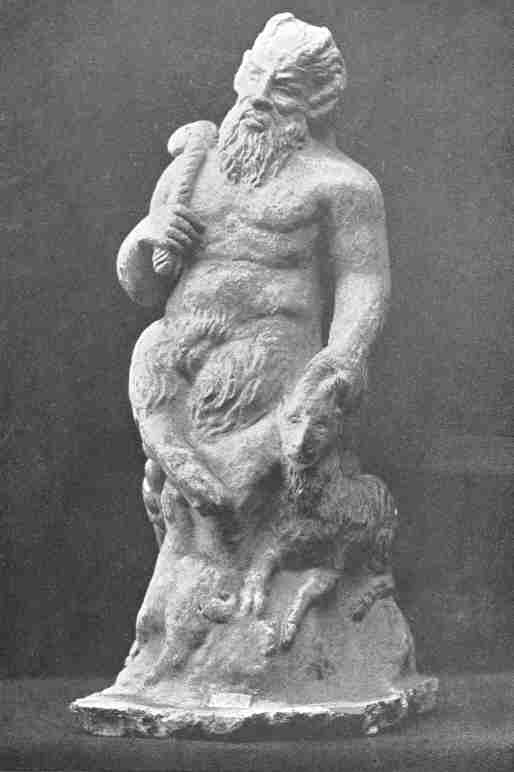
Tell me, Muse, concerning the dear son of Hermes, the goat-footed, the twy-horned, the lover of the din of revel, who haunts the wooded dells with dancing nymphs that tread the crests of the steep cliffs, calling upon Pan the pastoral God of the long wild hair. Lord is he of every snowy crest and mountain peak and rocky path. Hither and thither he goes through the thick copses, sometimes being drawn to the still waters, and sometimes faring through the lofty crags he climbs the highest peak whence the flocks are seen below; ever he ranges over the high white hills, and ever among the knolls he chases and slays the wild beasts, the God, with keen eye, and at evening returns piping from the chase, breathing sweet strains on the reeds. In song that bird cannot excel him which, among the leaves of the blossoming springtide, pours forth her plaint and her honey-sweet song. With him then the mountain nymphs, the shrill singers, go wandering with light feet, and sing at the side of the dark water of the well, while the echo moans along the mountain crest, and the God leaps hither and thither, and goes into the midst, with many a step of the dance. On his back he wears the tawny hide of a lynx, and his heart rejoices with shrill songs in the soft meadow where crocus and fragrant hyacinth bloom all mingled amidst the grass. They sing of the blessed Gods and of high Olympus, and above all do they sing of boon Hermes, how he is the fleet herald of all the Gods, and how he came to many-fountained Arcadia, the mother of sheep, where is his Cyllenian demesne, and there he, God as he was, shepherded the fleecy sheep, the thrall of a mortal man; for soft desire had come upon him to wed the fair-haired daughter of Dryops, and the glad nuptials he accomplished, and to Hermes in the hall she bare a dear son. From his birth he was a marvel to behold, goat-footed, twy-horned, a loud speaker, a sweet laugher. Then the nurse leaped up and fled when she saw his wild face and bearded chin. But him did boon Hermes straightway take in his hands and bear, and gladly did he rejoice at heart. Swiftly to the dwellings of the Gods went he, bearing the babe hidden in the thick skins of mountain hares; there sat he down by Zeus and the other Immortals, and showed his child, and all the Immortals were glad at heart, and chiefly the Bacchic Dionysus. Pan they called the babe to name: because he had made glad the hearts of all of them. Hail then to thee, O Prince, I am thy suppliant in song, and I shall be mindful of thee and of another lay.
1 comment:
Labels:
Ancient Greece,
Andrew Lang,
Dionysus,
God,
Hermes,
Homeric Hymns,
Mountain,
Zeus
Thursday, January 21, 2010
Images from "Stories of King Arthur's Knights"
Cover
The Lady Lyonors

Frontispiece
Beside her stood her beautiful daughter.

Through woods and swamps Enid and Geraint rode silently
The Lilly Maid of Astolat
Sir Pelleas was always at his lady's side.

Sometimes the birds and beasts, his woodland friends, would call to him

My strength is as the strength of ten because my heart is pure.
The Death of King Arthur
All Images from:
STORIES OF King Arthur’s Knights
TOLD TO THE CHILDREN BY MARY MACGREGOR
WITH PICTURES BY KATHARINE CAMERON
This eBook is for the use of anyone anywhere at no cost and with almost no restrictions whatsoever. You may copy it, give it away or re-use it under the terms of the Project Gutenberg License included with this eBook or online at www.gutenberg.org
Tuesday, January 19, 2010
Saturday, January 16, 2010
Friday, January 15, 2010
Symphony in Pink and Blue - James McNeill Whistler
Remorse
Deep in the silent inner room
Every fiber of my soft heart
Turns to a thousand strands of sorrow.
I loved the Spring,
But the Spring is gone
As rain hastens the falling petals.
I lean on the balustrade,
Moving from one end to the other.
My emotions are still disordered.
Where is he?
Withered grass stretches to the horizon
And hides from my sight
Any road by which he might return.
Li Ch'ing-chao translated by Kenneth Rexroth
Deep in the silent inner room
Every fiber of my soft heart
Turns to a thousand strands of sorrow.
I loved the Spring,
But the Spring is gone
As rain hastens the falling petals.
I lean on the balustrade,
Moving from one end to the other.
My emotions are still disordered.
Where is he?
Withered grass stretches to the horizon
And hides from my sight
Any road by which he might return.
Li Ch'ing-chao translated by Kenneth Rexroth
Wednesday, January 13, 2010
“The Problem of Evil ” by Fyodor Dostoevsky (excerpt from the Brothers Karamazov)
“Listen! I took the case of children only to make my case clearer. Of the other tears of humanity with which the earth is soaked from its crust to its centre, I will say nothing. I have narrowed my subject on purpose. I am a bug, and I recognise in all humility that I cannot understand why the world is arranged as it is. Men are themselves to blame, I suppose; they were given paradise, they wanted freedom, and stole fire from heaven, though they knew they would become unhappy, so there is no need to pity them. With my pitiful, earthly, Euclidian understanding, all I know is that there is suffering and that there are none guilty; that cause follows effect, simply and directly; that everything flows and finds its level—but that’s only Euclidian nonsense, I know that, and I can’t consent to live by it! What comfort is it to me that there are none guilty and that cause follows effect simply and directly, and that I know it?—I must have justice, or I will destroy myself. And not justice in some remote infinite time and space, but here on earth, and that I could see myself. I have believed in it. I want to see it, and if I am dead by then, let me rise again, for if it all happens without me, it will be too unfair. Surely I haven’t suffered simply that I, my crimes and my sufferings, may manure the soil of the future harmony for somebody else. I want to see with my own eyes the hind lie down with the lion and the victim rise up and embrace his murderer. I want to be there when everyone suddenly understands what it has all been for. All the religions of the world are built on this longing, and I am a believer. But then there are the children, and what am I to do about them? That’s a question I can’t answer. For the hundredth time I repeat, there are numbers of questions, but I’ve only taken the children, because in their case what I mean is so unanswerably clear. Listen! If all must suffer to pay for the eternal harmony, what have children to do with it, tell me, please? It’s beyond all comprehension why they should suffer, and why they should pay for the harmony. Why should they, too, furnish material to enrich the soil for the harmony of the future? I understand solidarity in sin among men. I understand solidarity in retribution, too; but there can be no such solidarity with children. And if it is really true that they must share responsibility for all their fathers’ crimes, such a truth is not of this world and is beyond my comprehension. Some jester will say, perhaps, that the child would have grown up and have sinned, but you see he didn’t grow up, he was torn to pieces by the dogs, at eight years old. Oh, Alyosha, I am not blaspheming! I understand, of course, what an upheaval of the universe it will be when everything in heaven and earth blends in one hymn of praise and everything that lives and has lived cries aloud: ‘Thou art just, O Lord, for Thy ways are revealed.’ When the mother embraces the fiend who threw her child to the dogs, and all three cry aloud with tears, ‘Thou art just, O Lord!’ then, of course, the crown of knowledge will be reached and all will be made clear. But what pulls me up here is that I can’t accept that harmony. And while I am on earth, I make haste to take my own measures. You see, Alyosha, perhaps it really may happen that if I live to that moment, or rise again to see it, I, too, perhaps, may cry aloud with the rest, looking at the mother embracing the child’s torturer, ‘Thou art just, O Lord!’ but I don’t want to cry aloud then. While there is still time, I hasten to protect myself, and so I renounce the higher harmony altogether. It’s not worth the tears of that one tortured child who beat itself on the breast with its little fist and prayed in its stinking outhouse, with its unexpiated tears to ‘dear, kind God’! It’s not worth it, because those tears are unatoned for. They must be atoned for, or there can be no harmony. But how? How are you going to atone for them? Is it possible? By their being avenged? But what do I care for avenging them? What do I care for a hell for oppressors? What good can hell do, since those children have already been tortured? And what becomes of harmony, if there is hell? I want to forgive. I want to embrace. I don’t want more suffering. And if the sufferings of children go to swell the sum of sufferings which was necessary to pay for truth, then I protest that the truth is not worth such a price. I don’t want the mother to embrace the oppressor who threw her son to the dogs! She dare not forgive him! Let her forgive him for herself, if she will, let her forgive the torturer for the immeasurable suffering of her mother’s heart. But the sufferings of her tortured child she has no right to forgive; she dare not forgive the torturer, even if the child were to forgive him! And if that is so, if they dare not forgive, what becomes of harmony? Is there in the whole world a being who would have the right to forgive and could forgive? I don’t want harmony. From love for humanity I don’t want it. I would rather be left with the unavenged suffering. I would rather remain with my unavenged suffering and unsatisfied indignation, even if I were wrong. Besides, too high a price is asked for harmony; it’s beyond our means to pay so much to enter on it. And so I hasten to give back my entrance ticket, and if I am an honest man I am bound to give it back as soon as possible. And that I am doing. It’s not God that I don’t accept, Alyosha, only I most respectfully return him the ticket.”
“That’s rebellion,” murmured Alyosha, looking down.
More Here
“That’s rebellion,” murmured Alyosha, looking down.
More Here
Tuesday, January 12, 2010
Monday, January 11, 2010
Underneath all the texts - Hildegard of Bingen
Underneath all the texts, all the sacred psalms and canticles, these watery varieties of sounds and silences, terrifying, mysterious, whirling and sometimes gestating and gentle must somehow be felt in the pulse, ebb, and flow of the music that sings in me. My new song must float like a feather on the breath of God.
St. Hildegard of Bingen
Sunday, January 10, 2010
Annabel Lee - James McNeill Whistler
It was many and many a year ago,
In a kingdom by the sea,
That a maiden there lived whom you may know
And this maiden she lived with no other thought
Than to love and be loved by me.
I was a child and she was a child,
In this kingdom by the sea:
But we loved with a love that was more than love -
I and my Annabel Lee;
With a love that the winged seraphs of heaven
Coveted her and me.
And this was the reason that, long ago,
In this kingdom by the sea,
A wind blew out of a cloud, chilling
My beautiful Annabel Lee;
So that her high-born kinsmen came
And bore her away from me,
To shut her up in a sepulchre
In this kingdom by the sea.
The angels, not half so happy in heaven,
Went envying her and me -
Yes! that was the reason (as all men know,
In this kingdom by the sea)
That the wind came out of the cloud one night,
Chilling and killing my Annabel Lee.
But our love it was stronger by far than the love
Of those who were older than we -
Of many far wiser than we -
And neither the angels in heaven above,
Nor the demons down under the sea,
Can ever dissever my soul from the soul
Of the beautiful Annabel Lee;
For the moon never beams without bringing me dreams
Of the beautiful Annabel Lee;
And the stars never rise but I feel the bright eyes
Of the beautiful Annabel Lee;
And so, all the night-tide, I lie down by the side
Of my darling -my darling -my life and my bride,
In the sepulchre there by the sea -
Saturday, January 9, 2010
A whole concert of grunting
"Howard Roark built a temple to the human spirit. He saw man as strong, proud, clean, wise and fearless. He saw man as a heroic being. And he built a temple to that. A temple is a place where man is to experience exaltation. He thought that exaltation comes from the consciousness of being guiltless, of seeing the truth and achieving it, of living up to one's highest possability, of knowing no shame and having no cause for shame, of being able to stand naked in the full sunlight. He thought that exaltation means joy and that joy is man's birthright. He thought that a place built as a setting for man is a sacred place. That is what Howard Roark thought of man and of exaltation..."
"I condemn Howard Roark. A building they say must be part of its site. In what kind of world did Roark build his temple? For what kind of men? Look around you... When you see a man casting pearls without getting even a pork chop in return - it is not against the swine that you feel indignation. It is against the man who valued his pearls so little that he was willing to fling them into the muck and let them become the occasion for a whole concert of grunting, transcribed by the court stenographer."
Ayn Rand - The Fountainhead
"I condemn Howard Roark. A building they say must be part of its site. In what kind of world did Roark build his temple? For what kind of men? Look around you... When you see a man casting pearls without getting even a pork chop in return - it is not against the swine that you feel indignation. It is against the man who valued his pearls so little that he was willing to fling them into the muck and let them become the occasion for a whole concert of grunting, transcribed by the court stenographer."
Ayn Rand - The Fountainhead
Moonset Over Superior
"It could be said that the very structure of the cosmos keeps memory of the celestial supreme being alive. It is as if the gods had created the world in such a way that it could not but reflect their existence; for no world is possible without verticality, and that dimension alone is enough to evoke transcendence."
Mircea Eliade - The Sacred and the Profane
The Jack Pine - Tom Thompson
Subscribe to:
Posts (Atom)