Tuesday, August 31, 2010

Otto Dix - War Images

Otto Dix (1891-1969) via Encyclopedia of Irish &World Art

The German painter and printmaker Wilhelm Heinrich Otto Dix was one of the greatest and most powerful representatives of the post-war satirical style of German Expressionism, which flourished during the 1920s in Berlin, Dresden, Mannheim and other major cities. The target for Dix's satirical, often brutal style of expressionism was the horror of war, of which he had first-hand experience, and the decadent depravities of the post-war Weimar Republic. A member of Die Neue Sachlichkeit (New Objectivity) school, Dix was banned by the Nazis who classified his art as degenerate. Acknowledged as one of the greatest post-war expressionist painters, his 1920s paintings are regarded as some of the finest anti-war pictures of modern art.


The Trench

Stormtroopers Advancing Under Gas - 1924

Machine Gunner Advancing


Meal Time in the Trenches - 1923/24


Trenches - 1917


Flandern - 1934


Friday, August 27, 2010

Some good things from the IMA


The Indianapolis Museum of Art.

Take a look at pages from The Red Book by Carl Jung | Books | guardian.co.uk

Take a look at pages from The Red Book by Carl Jung | Books | guardian.co.uk

The Red Book by Carl Jung


During the first world war, Carl Jung embarked on an extended self-exploration he called his 'confrontation with the unconscious'. At the heart of this exploration was The Red Book, a grand, illuminated volume which he created between 1914 and 1930, in which he developed the nucleus of his later theories.

The book is a remarkable blend of calligraphy and art; an illuminated manuscript that bears comparison with The Book of Kells and William Blake. But while Jung considered The Red Book his most important work, only a handful of people have ever seen it. Finally, nearly 80 years after it was completed, it is available in a facsimile edited by Jung historian Sonu Shamdasani and published by WW Norton. View a handful of the pages here.

A Journey Round My Skull: Warsaw Warble

One of my favorite design blogs. Check it out!
A Journey Round My Skull: Warsaw Warble

Thursday, March 25, 2010

Jacob Wrestles with an Angel

 Jacob wrestling with the Angel - Paul Gauguin
24 And Jacob was left alone; and there wrestled a man with him until the breaking of the day.

25 And when he saw that he prevailed not against him, he touched the hollow of his thigh; and the hollow of Jacob's thigh was out of joint, as he wrestled with him.

26 And he said, Let me go, for the day breaketh. And he said, I will not let thee go, except thou bless me.

27 And he said unto him, What [is] thy name? And he said, Jacob.

28 And he said, Thy name shall be called no more Jacob, but Israel: for as a prince hast thou power with God and with men, and hast prevailed.

29 And Jacob asked [him], and said, Tell [me], I pray thee, thy name. And he said, Wherefore [is] it [that] thou dost ask after my name? And he blessed him there.

30 And Jacob called the name of the place Peniel: for I have seen God face to face, and my life is preserved.

Genesis 32:24-30 KJV

Tuesday, March 16, 2010

Kingdom of the Dead (Excerpt from Virgil)

Excerpts from the Aeneid of Virgil
translated by Robert Fagles


Virgil
Now carved out of the rocky flanks of Cumae
lies an enormous cavern pierced by a hundred tunnels,
a hundred mouths with as many voices rushing out,
the Sibyl's rapt replies. They had just gained
the sacred sill when the virgin cries aloud:
"Now is the the time to ask your fate to speak!
The god, look, the god!"
               So she cries before
the enterance - suddenly all her features, all
her color changes, her braided hair flies loose
and her breast heaves, her heart bursts with frenzy,
she seems to rise in height, the ring of her voice no longer
human - the breath, the power of god comes closer, closer.
"Why so slow, Trojan Aeneas?" she shouts, "so slow
to pray, to swear your vows? Not until you do
will the great jaws of our spellbound house gape wide."
And with that command the prophetess fell silent....

               "....But grant one prayer.
Since here, they say, are the gates of Death's king
and the dark marsh where the Acheron comes flooding up,
please, allow me to go and see my beloved father,
meet him face-to-face.
Teach me the way, throw wide the sacred doors!...."


The Sybil of Cumae
              ..So he prayed,
grasping the alter while the Sibyl gave her answer:
"Born of the blood of gods, Anchises' son,
man of Troy, the descent to the Underworld is easy.
Night and day the gates of shadowy Death stand open wide,
but to retrace your steps, to climb back to the upper air-
there the struggle, there the labor lies. Only a few,
loved by impartial Jove or born aloft to the sky
by their own fiery virtue - some sons of the gods
have made their way. The entire heartland here
is thick with woods, Cocytus glides around it,
coiling dense and dark.
But if such a wild desire seizes on you - twice
to sail the Stygian marsh, to see black Tartarus twice -
if you're so eager to give yourself to this, this mad ordeal,
then hear what you must accomplish first.
              Hidden
deep in a shady tree there grows a golden bough,
its leaves and its hardy, sinewy stem all gold,
held sacred to Juno of the Dead, Porserpina.
The whole grove covers it over, dusky valleys
enfold it too, closing around it. No one
may pass below the secret places of the earth before
he plucks the fruit, the golden foliage of that tree.
As her beauty's due, Proserpina decreed this bough
shall be offered up to her as her own hallowed gift.
When the first spray's torn away, another takes its place,
gold too, the metal breaks into leaf again, all gold.
Lift up your eyes and search, and once you find it,
duly pluck it off with your hand. Freely, easily,
all by itself it comes away, if Fate calls you on.
If not, no strenght within you can overpower it,
no iron blade, however hard, can tear it off...."

Reblog this post [with Zemanta]

Friday, March 12, 2010

The Cattle of the Sun from The Odyssey by Homer

Bull for the Cave Paintings at Lascaux

A truly horrifying scene, where, after killing and dismembering the sun god Helios' cattle, and roasting them as a sacrifice, they return to life, but still in pieces.
'As soon as I reached our ship at the water's edge
I took the men to task, upbraiding each in turn,
but how to set things right? We couldn't find a way.
The cattle were dead already...
and the gods soon showed us all some fateful signs-
the hides began to crawl, the meat both raw and roasted,
bellowed out on the spits, and we heard a noise
like the moan of lowing oxen'
translated by Robert Fagles

The Land of the Dead

Death on a Pale Horse - J.M.W. Turner
   Sooner or later the hero travels to the Land of the Dead, the shadow realm... seeking secret knowledge. What world is this of half light, and half truths, and half remembered things, where those who used to walk with us are now but phantoms of their former selves? Memories, I say. Not of the deceased alone, but of the departed, the unreachable ones, those who have passed away either in mind or in body or in spirit. And the only form they have now is that which the hero imparts to them by his rememberance.
   There can be no satisfaction gained here; the elixir will not be obtained. For when we question those who reside here, we merely question ourselves, our memory, the simulacrum of those who have passed far and strange away from us, and who are out of ear shot. And what can we tell ourselves about what those who are not here might think? Nothing... and what is more, when we speak with them (in our thoughts), we become as them... faded and wan and little more than a ghost of what we once were when life was all about. This is the meaning of the hero passing yonder. And what is the secret knowledge that he seeks? What balm? Just this, that he too is a ghost haunting someone else's dark dream. It is the death wish, the desire to be remembered; but with that also, to be as faded as these pale reflections and less than alive.

Eidolons from Leaves of Grass by Walt Whitman

Hermes as Psychopomp
I met a seer,
Passing the hues and objects of the world,
The fields of art and learning, pleasure, sense,
To glean eidolons.
Put in thy chants said he,
No more the puzzling hour nor day, nor segments, parts, put in,
Put first before the rest as light for all and entrance-song of all,
That of eidolons.

Ever the dim beginning,
Ever the growth, the rounding of the circle,
Ever the summit and the merge at last, (to surely start again,)
Eidolons! eidolons!

Ever the mutable,
Ever materials, changing, crumbling, re-cohering,
Ever the ateliers, the factories divine,
Issuing eidolons.

Lo, I or you,
Or woman, man, or state, known or unknown,
We seeming solid wealth, strength, beauty build,
But really build eidolons.


The ostent evanescent,
Myrrha,  Gustave DorĂ©
The substance of an artist's mood or savan's studies long,
Or warrior's, martyr's, hero's toils,
To fashion his eidolon.

Of every human life,
(The units gather'd, posted, not a thought, emotion, deed, left out,)
The whole or large or small summ'd, added up,
In its eidolon.
The old, old urge,
Based on the ancient pinnacles, lo, newer, higher pinnacles,
From science and the modern still impell'd,
The old, old urge, eidolons.

The present now and here,
America's busy, teeming, intricate whirl,
Of aggregate and segregate for only thence releasing,
To-day's eidolons.

These with the past,
Of vanish'd lands, of all the reigns of kings across the sea,
Old conquerors, old campaigns, old sailors' voyages,
Joining eidolons.

Densities, growth, facades,
Strata of mountains, soils, rocks, giant trees,
Far-born, far-dying, living long, to leave,
Eidolons everlasting.

Exalte, rapt, ecstatic,
The visible but their womb of birth,
Of orbic tendencies to shape and shape and shape,
The mighty earth-eidolon.

All space, all time,
(The stars, the terrible perturbations of the suns,
Swelling, collapsing, ending, serving their longer, shorter use,)
Fill'd with eidolons only.

The noiseless myriads,
The infinite oceans where the rivers empty,
The separate countless free identities, like eyesight,
The true realities, eidolons.

Not this the world,
Nor these the universes, they the universes,
Purport and end, ever the permanent life of life,
Eidolons, eidolons.

Beyond thy lectures learn'd professor,
Beyond thy telescope or spectroscope observer keen, beyond all mathematics,
Beyond the doctor's surgery, anatomy, beyond the chemist with his chemistry,
The entities of entities, eidolons.

Unfix'd yet fix'd,
Ever shall be, ever have been and are,
Sweeping the present to the infinite future,
Eidolons, eidolons, eidolons.

The prophet and the bard,
Shall yet maintain themselves, in higher stages yet,
Shall mediate to the Modern, to Democracy, interpret yet to them,
God and eidolons.

And thee my soul,
Joys, ceaseless exercises, exaltations,
Thy yearning amply fed at last, prepared to meet,
Thy mates, eidolons.

Thy body permanent,
The body lurking there within thy body,
The only purport of the form thou art, the real I myself,
An image, an eidolon.

Thy very songs not in thy songs,
No special strains to sing, none for itself,
But from the whole resulting, rising at last and floating,
A round full-orb'd eidolon.

Tuesday, March 2, 2010

From The Marriage of Heaven and Hell
by William Blake


The voice of the Devil

   All Bibles or sacred codes have been the causes of the following Errors:
   1. That Man has two real existing principles: Viz: a Body & a Soul.
   2. That Energy, call'd Evil, is alone from the Body; & that Reason, call'd Good, is alone from the Soul.
   3. That God will torment Man in Eternity for following his Energies.
   But the following Contraries to these are True:
   1. Man has no Body distinct from his Soul; for that call'd Body is a portion of Soul discern'd by the five Senses, the chief inlets of Soul in this age.
   2. Energy is the only life, and is from the Body; and Reason is the bound or outward circumference of Energy.
   3. Energy is Eternal Delight.


Tuesday, February 23, 2010

Axis Mundi


   The cry of the Kwakiutl neophyte, "I am at the Center of the World!" at once reveals one of the deepest meanings of sacred space. Where the break-through from plane to plane has been effected by a hierophany, there too an opening has been made, either upward (the divine world) or downward (the underworld, the world of the dead). The three cosmic levels - earth, heaven, underworld - have been put in communication. As we just saw, this communication is sometimes expressed through the image of a universal pillar, axis mundi, which at once connects and supports heaven and earth and whose base is fixed in the world below (the infernal regions). Such a pillar can be only at the very center of the universe, for the whole of the habitable world extends around it....
....

   To us, it seems an inescapable conclusion that the religious man sought to live as near as possible to the Center of the World. He knew that his country lay at the midpoint of the earth; he knew too that his city constituted the navel of the universe, and, above all, that the temple or the palace were veritably Centers of the World. But he also wanted his own house to be at the Center and to be an imago mundi. And, in fact, as we shall see, houses are held to be at the Center of the World, and on the microcosmic scale, to reproduce the universe. In other words, the man of traditional societies could only live in a space opening upward, where the break in the plane was symbolically assured and hence communication with the other world, the transcendental world, was ritually possible. Of course the sanctuary - the Center par excelence - was there, close to him, in the city, and he could be sure of communicating with the world of the gods simply by entering the temple. But he felt the need to live at the center always - like the Achipla, who, as we saw, always carried the sacred pole, the axis mundi, with them, so they should never be far from the Center and should remain in communication with the supernatural world. In short, whatever the dimensions of the space with which he is familiar and in which he regards himself as situated - his country, his city, his village, his house - religious man feels the need always to exist in a total and organized world, in a cosmos.


excerpt from The Sacred and the Profane by Mircea Eliade
Reblog this post [with Zemanta]

Monk by the Sea by Caspar David Friedrich


While keeping my physical frame I lost sight of my real self. Gazing at muddy water, I lost sight of the clear abyss. - Chuang-tse

Wednesday, February 3, 2010

Maybe an old memory.

   Only a year ago Mary's brother Dennis died in our house, died dreadfully, of an infection of the thyroid that forced the juices of fear through him so that he was violent and terrified and fierce. His kindly Irish horse-face grew bestial. I helped to hold him down, to pacify and reassure him in his death-dreaming, and it went on for a week, before his lungs began to fill. I didn't want Mary to see him die. She had never seen death, and this one, I knew, might wipe out her sweet memory of a kindly man who was her brother. Then, as I sat waiting by his bed, a monster swam up out of my dark water. I hated him. I wanted to kill him, to bite out his throat. My jaw muscles tightened and I think my lips fleered back like a wolf's at the kill.
   When it was over, in panic guilt I confessed what I had felt to old Doc Peele, who signed the death certificate.
   "I don't think it's unusual," he said. "I've seen it on people's faces, but few admit it."
   "But what causes it? I liked him."
   "Maybe an old memory," he said. "Maybe a return to the time of the pack when a sick or hurt member was a danger. Some animals and most fish tear down and eat a weakened brother."
   "But I'm not an animal - or a fish."
   "No, you're not. And perhaps that's why you find it foreign. But it's there. It's all there."
   He's a good man, Doc Peele, a tired old man. He's birthed and buried us for fifty years.


from The Winter of our Discontent - John Steinbeck
Reblog this post [with Zemanta]

Friday, January 22, 2010

Arnold Bocklin via Boing Boing


Homeric Hymns
translated by Andrew Lang


XVIII.  TO PAN


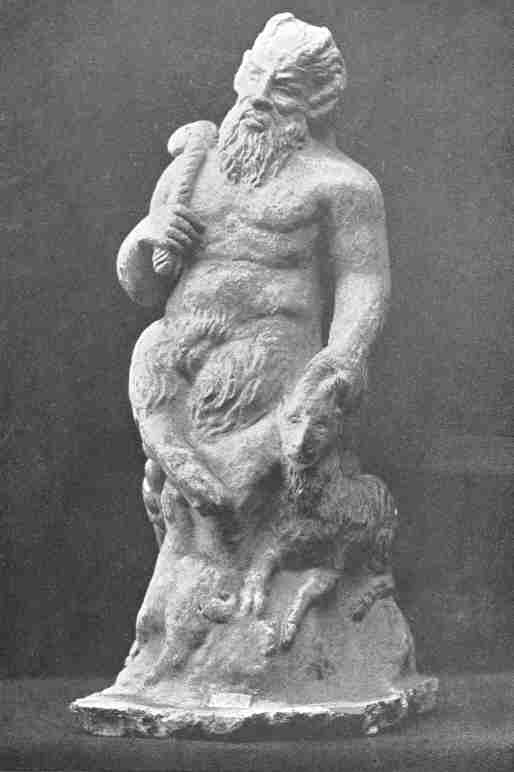
Tell me, Muse, concerning the dear son of Hermes, the goat-footed, the twy-horned, the lover of the din of revel, who haunts the wooded dells with dancing nymphs that tread the crests of the steep cliffs, calling upon Pan the pastoral God of the long wild hair.  Lord is he of every snowy crest and mountain peak and rocky path.  Hither and thither he goes through the thick copses, sometimes being drawn to the still waters, and sometimes faring through the lofty crags he climbs the highest peak whence the flocks are seen below; ever he ranges over the high white hills, and ever among the knolls he chases and slays the wild beasts, the God, with keen eye, and at evening returns piping from the chase, breathing sweet strains on the reeds.  In song that bird cannot excel him which, among the leaves of the blossoming springtide, pours forth her plaint and her honey-sweet song.  With him then the mountain nymphs, the shrill singers, go wandering with light feet, and sing at the side of the dark water of the well, while the echo moans along the mountain crest, and the God leaps hither and thither, and goes into the midst, with many a step of the dance.  On his back he wears the tawny hide of a lynx, and his heart rejoices with shrill songs in the soft meadow where crocus and fragrant hyacinth bloom all mingled amidst the grass.  They sing of the blessed Gods and of high Olympus, and above all do they sing of boon Hermes, how he is the fleet herald of all the Gods, and how he came to many-fountained Arcadia, the mother of sheep, where is his Cyllenian demesne, and there he, God as he was, shepherded the fleecy sheep, the thrall of a mortal man; for soft desire had come upon him to wed the fair-haired daughter of Dryops, and the glad nuptials he accomplished, and to Hermes in the hall she bare a dear son.  From his birth he was a marvel to behold, goat-footed, twy-horned, a loud speaker, a sweet laugher.  Then the nurse leaped up and fled when she saw his wild face and bearded chin.  But him did boon Hermes straightway take in his hands and bear, and gladly did he rejoice at heart.  Swiftly to the dwellings of the Gods went he, bearing the babe hidden in the thick skins of mountain hares; there sat he down by Zeus and the other Immortals, and showed his child, and all the Immortals were glad at heart, and chiefly the Bacchic Dionysus.  Pan they called the babe to name: because he had made glad the hearts of all of them.  Hail then to thee, O Prince, I am thy suppliant in song, and I shall be mindful of thee and of another lay.


Thursday, January 21, 2010

Images from "Stories of King Arthur's Knights"


Cover
The Lady Lyonors


Frontispiece
Beside her stood her beautiful daughter.


Through woods and swamps Enid and Geraint rode silently


The Lilly Maid of Astolat


Sir Pelleas was always at his lady's side.


Sometimes the birds and beasts, his woodland friends, would call to him


My strength is as the strength of ten because my heart is pure.


The Death of King Arthur


All Images from:


TOLD TO THE CHILDREN BY MARY MACGREGOR
WITH PICTURES BY KATHARINE CAMERON


This eBook is for the use of anyone anywhere at no cost and with
almost no restrictions whatsoever.  You may copy it, give it away or
re-use it under the terms of the Project Gutenberg License included
with this eBook or online at www.gutenberg.org

Friday, January 15, 2010

Symphony in Pink and Blue - James McNeill Whistler


Remorse
Deep in the silent inner room
Every fiber of my soft heart
Turns to a thousand strands of sorrow.
I loved the Spring,
But the Spring is gone
As rain hastens the falling petals.
I lean on the balustrade,
Moving from one end to the other.
My emotions are still disordered.
Where is he?
Withered grass stretches to the horizon
And hides from my sight
Any road by which he might return.

Li Ch'ing-chao translated by Kenneth Rexroth